

TL;DR
AEO matters because visibility drives growth. If buyers are using AI to research problems, compare options and shortlist providers, your brand needs to show up in those answers. Otherwise, you risk becoming invisible at the exact moment potential customers are deciding who to trust.
“AEO is like AI asking, ‘Can I use this brand to answer the buyer’s question?’ Your job is to make the answer yes.”
What is AEO?
AEO, or Answer Engine Optimisation, is the practice of optimising your brand so it shows up in AI-generated answers.
Traditional SEO is about helping your brand appear in search results. AEO goes one step further: it is about helping your brand become part of the answer itself.
That matters because buyers are no longer only typing questions into Google and scanning blue links. They are asking tools like ChatGPT, Gemini, Perplexity and Google AI search for direct answers, recommendations, comparisons and shortlists. HubSpot describes AI search platforms as tools that generate synthesised answers rather than simply returning a list of links, often shaping brand perception before a buyer ever reaches your website. (HubSpot)
For a business that relies on being found, trusted and shortlisted, that is a major shift.
Why mid-market businesses should care now
For mid-market businesses, especially those with complex sales cycles and multiple stakeholders, visibility is not just a marketing metric. It is a revenue issue.
An example ideal buyer profile includes organisations with 200–2,000+ employees, $100K+ budgets, and decision-makers based across Australia or New Zealand. These businesses often have senior stakeholders involved across marketing, sales, technology and commercial leadership.
That means buyers are not making quick, simple decisions. They are researching. Comparing. Validating. Asking questions before they speak to sales.
Those questions might include:
- “Who is the best HubSpot partner in New Zealand?”
- “How much does a HubSpot implementation cost?”
- “How do I migrate from Salesforce to HubSpot?”
- “What should I look for in a HubSpot partner?”
- “Is HubSpot right for a complex B2B sales process?”
- “How do I integrate HubSpot with my existing tech stack?”
If your brand does not appear when those questions are asked, you are not just missing a search ranking. You are missing a buying moment.
For a growth leader, that creates a visibility problem. They care about revenue growth, sales effectiveness, ROI, and cross-team alignment. If competitors are showing up in AI-generated answers and you are not, they are influencing the buyer before your sales team even knows that the buyer exists.
AEO does not replace SEO, it builds on it
AEO is not a shortcut around SEO.
Traditional SEO is the foundation of AEO. AI tools still need to discover, understand and trust your content before they can recommend it. That means the fundamentals still matter:
- Domain authority
- Technical crawlability
- Keyword relevance
- Strong page structure
- Useful content
- Internal linking
- Schema and structured data
- Topical authority
- Credible third-party signals
The difference is the outcome you are optimising for.
With SEO, the goal is often to rank.
With AEO, the goal is to be trusted enough to be included in the answer.
A simple way to think about it:
"SEO gets your brand into the search results. AEO gets your brand into the actual answer."
-1.png?width=524&height=498&name=SEO%20(3)-1.png)
AEO brings us back to inbound
In many ways, AEO follows the same logic as inbound marketing: answer the questions your ideal customers are already asking.
The difference is that the “reader” is now both the buyer and the AI layer interpreting, summarising and recommending content on their behalf.
That means generic content will not be enough. Brands need to create content that directly answers the questions their ICPs are asking at every stage of the decision process.
Early-stage questions might include:
- “What is AEO?”
- “Why does AI search matter for B2B marketing?”
- “How do I know if my CRM is holding back growth?”
Mid-stage questions might include:
- “How much does a HubSpot implementation cost?”
- “How long does a HubSpot migration take?”
- “What should I look for in a HubSpot partner?”
Decision-stage questions might include:
- “Who is the best HubSpot partner in New Zealand?”
- “Which HubSpot partner is best for a mid-market business?”
- “What results can a HubSpot partner actually deliver?”
The goal is not to publish more content for the sake of it. The goal is to give your buyer everything they need to make a confident decision.
The biggest misconception about AEO
The biggest mistake businesses make is treating AEO like a content task.
Owned content matters, but it is only part of the picture. AEO is also shaped by the wider ecosystem around your brand: what other people say about you, where you are mentioned, how you are reviewed, and whether the market validates your positioning.
HubSpot’s guidance describes AEO as involving both content optimisation and visibility across different channels, noting that pages, social media posts and other content can all contribute to the strategy. (HubSpot Knowledge Base) HubSpot also explains that AI brand sentiment reflects how language models synthesise signals from social media, reviews, news and wider sources into a consolidated representation of your brand. (HubSpot)
That is why AEO is not just about what you say on your own website. It is also about what the market says when you are not in the room.
The three signal types in an AEO audit
A practical AEO audit should look at three areas: owned content, third-party validation and UGC/community sentiment.
1. Owned content
This is what your brand controls directly.
It includes your website pages, HubSpot landing pages, blogs, FAQs, service pages, case studies, pillar pages, knowledge base articles and social posts.
The audit question is:
Does our content clearly answer the questions our buyers are asking?
For HubSpot customers, this might mean reviewing:
- website pages
- blog posts
- landing pages
- topic clusters
- CTAs
- forms
- case studies
- knowledge base content
- campaign reporting
- CRM insights
- social posts
HubSpot becomes especially powerful when it connects what buyers ask, what your content answers, what your CRM reveals, and what your market repeats back about your brand.
2. Third-party reviews and validation
This is what proves that other people trust you.
It includes, but not limited to:
- Customer reviews
- HubSpot partner directory presence
- Industry directories
- Awards
- User-generated content
- Comparison articles
- Testimonials
- Case studies
- Partner ecosystem signals
The audit question is:
When AI tools look beyond our website, do they find enough credible proof that we are a trusted answer?
For a HubSpot implementation partner, this could include visibility around searches such as “best HubSpot partner in New Zealand” or “best HubSpot partner for mid-market businesses in Australia”.
3. UGC and community sentiment
This is what the market says in places you do not fully control.
It includes:
- Reddit threads
- LinkedIn conversations
- Comments
- Community forums
- Customer discussions
- Third-party review sites
- Social mentions
- Peer recommendations
The audit question is:
Are people talking about our brand in a way that reinforces how we want to be understood?
You cannot control every conversation, but you can influence the ecosystem. Encourage reviews. Create useful discussions. Show up in community spaces. Secure relevant publication opportunities. Make sure your message is consistent across every channel.
How to improve AEO in HubSpot
-1.svg)
For businesses already using HubSpot, AEO should be treated as a connected programme across content, CRM, campaigns and reporting.
A practical process could look like this.
Step 1: Find the questions your buyers are asking
Do not guess. Mine the places where buyer questions already exist:
- Sales call notes
- Lost deal reasons
- Form submissions
- Live chat
- Demo requests
- Customer success conversations
- Implementation questions
- Google Search Console
- CRM notes
- AI search prompts
- Review sites
- Competitor comparisons
Look for repeated questions around cost, risk, timelines, migration, integrations, proof, support and vendor comparison.
Step 2: Audit your existing content
Map your owned content against the questions buyers are asking.
Look for gaps. For example:
- Do you explain your implementation process clearly?
- Do you answer pricing and timeline questions?
- Do you have comparison content?
- Do you show proof through case studies?
- Do your service pages explain who you are best suited for?
- Do your blogs answer commercially meaningful questions?
- Do your social posts reinforce the same themes?
Step 3: Build or improve the right assets
Depending on the gaps, you may need to create or optimise:
- Service pages
- Comparison pages
- FAQs
- Implementation guides
- Migration guides
- HubSpot topic clusters
- Case studies
- Customer proof pages
- Social post series
- Sales enablement content
- Knowledge base articles
The best AEO content is specific, useful and decision-oriented. It should help the buyer move from uncertainty to confidence.
Step 4: Strengthen external proof
AEO is not only built on your own site.
You should also improve the external signals around your brand by:
- Encouraging customers to leave detailed reviews
- Strengthening directory profiles
- Earning relevant backlinks
- Investing in credible publication opportunities
- Participating in community conversations
- Building customer advocacy
- Creating consistent messaging across sales, marketing and social channels
Step 5: Track visibility over time
AEO should not be measured once and forgotten.
HubSpot’s AEO product allows teams to track specific prompts relevant to their business and see how often their brand and competitors appear in AI-generated answers. (HubSpot) HubSpot also recommends using the free AEO Grader for a snapshot of answer engine visibility, then using HubSpot AEO for ongoing prompt tracking, competitor analysis and prioritised recommendations. (HubSpot Knowledge Base)
Example prompts to track:
- “Who is the best HubSpot partner in New Zealand?”
- “Best HubSpot partner for mid-market B2B companies in Australia”
- “How much does a HubSpot implementation cost?”
- “How do I migrate from Salesforce to HubSpot?”
- “What should I look for in a HubSpot partner?”
The important thing is that prompts reflect real buyer language, not internal marketing language.
How to measure AEO success in HubSpot
AEO success starts with knowing whether your brand is visible in the AI-generated answers your buyers are likely to see.
In HubSpot, you can track your overall AEO score, monitor brand visibility, review sentiment analysis, and compare how your brand appears against competitors. You can also track specific prompts, see which channels or sources are being cited, and identify where your brand is missing from the answers that matter.
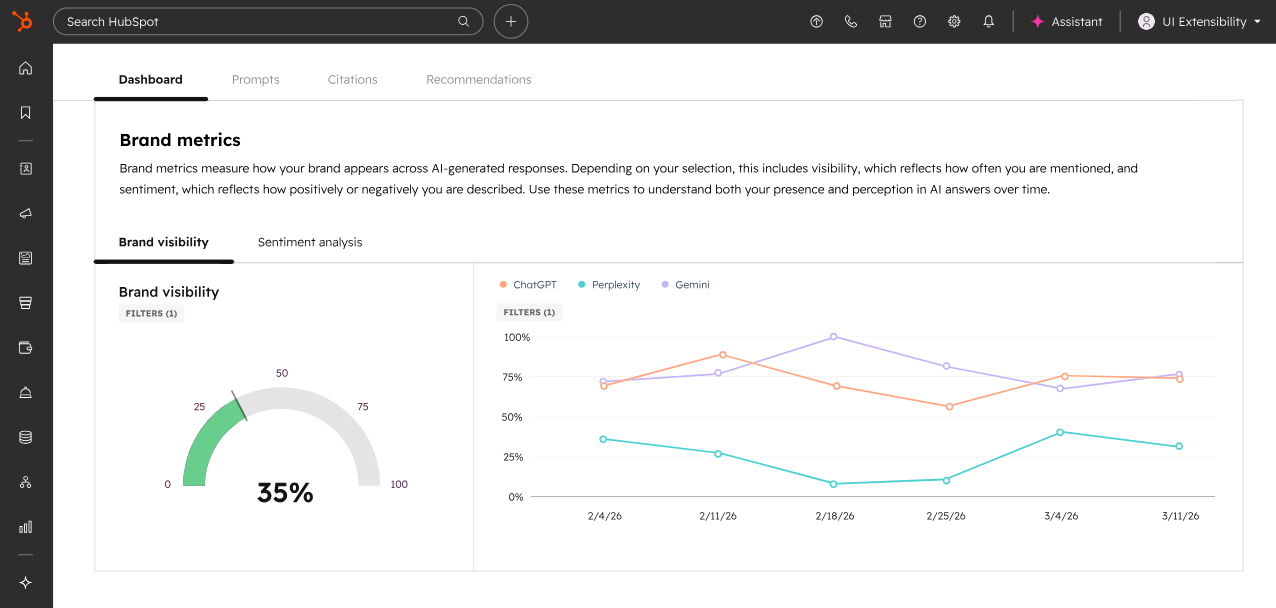
For example, Avidly APAC might track prompts such as:
- “Who is the best HubSpot partner in New Zealand?”
- “Best HubSpot partner for mid-market B2B companies in Australia”
- “How much does a HubSpot implementation cost?”
- “How do I migrate from Salesforce to HubSpot?”
- “What should I look for in a HubSpot partner?”
The useful measures inside HubSpot include:
- AEO score: a high-level view of your current AI search visibility
- Brand visibility: whether your brand is appearing in AI-generated answers
- Prompt tracking: how your brand performs against specific buyer questions
- Competitor comparison: how your visibility compares to competing brands
- Sentiment analysis: how AI interprets the wider conversation around your brand
- Cited channels and sources: which websites, platforms or content sources are being used in AI answers
The key is to track prom
pts that reflect real buying intent. It is not enough to monitor broad or generic questions. You want to know whether your brand appears when buyers are asking questions that influence vendor shortlists, partner selection and commercial decisions.
Common AEO mistakes to avoid
The most common mistake is forgetting that AEO is heavily influenced by sentiment and external validation.
Other red flags include:
- Tracking vanity prompts no real buyer would ask
- Focusing only on owned content
- Ignoring third-party reviews
- Overlooking UGC and community conversations
- Creating content without fixing SEO foundations
- Failing to compare against competitors
- Measuring visibility once instead of tracking it over time
- Not connecting AEO insights back into HubSpot campaigns and sales enablement
The key lesson is simple:
You do not control sentiment the same way you control a landing page, but you can influence it by consistently showing up, earning trust and making your message clear across the whole market.
The strategic takeaway
AEO is now fundamental for any business that wants to stay visible in modern search.
If SEO helped brands get found on Google, AEO helps brands get recommended in the answers buyers now trust.
For mid-market businesses, this is more than a marketing trend. It is a visibility, trust and pipeline issue. If your competitors are appearing in AI-generated answers and you are not, they are shaping the buyer’s shortlist before you get a chance to make your case.
AEO is not about gaming AI. It is about becoming the clearest, most credible and most useful answer to the questions your buyers are already asking.

Ready to understand where your brand stands?
Start by getting a baseline understanding of where your business stands with HubSpot’s free AEO Grader. HubSpot positions the grader as a way to assess your brand’s AI visibility, competitive positioning and recommendations. (HubSpot)
Book an AEO audit with us
We’ll help you understand where your brand shows up in AI search today, which buyer questions you are missing, how competitors are appearing, and what to improve across owned content, third-party reviews, UGC, sentiment and HubSpot.
Comments