


The Problem: A Data Backlog That Would Take Years to Clear
A mid-market organisation had a straightforward but painful problem.
They had 1,501 property listings that needed SEO meta descriptions. Their team had manually completed 51 of them.
At that pace, full completion wasn't a quarter away. It wasn't even a year away. It was years, and in the meantime, every unpopulated listing was a missed opportunity in search.
This wasn't a content strategy problem. It wasn't a skills problem. It was a volume problem. The kind that doesn't get solved by hiring more people or working longer hours.
It needed a systems solution.
The Solution: AI Embedded Directly in the Workflow
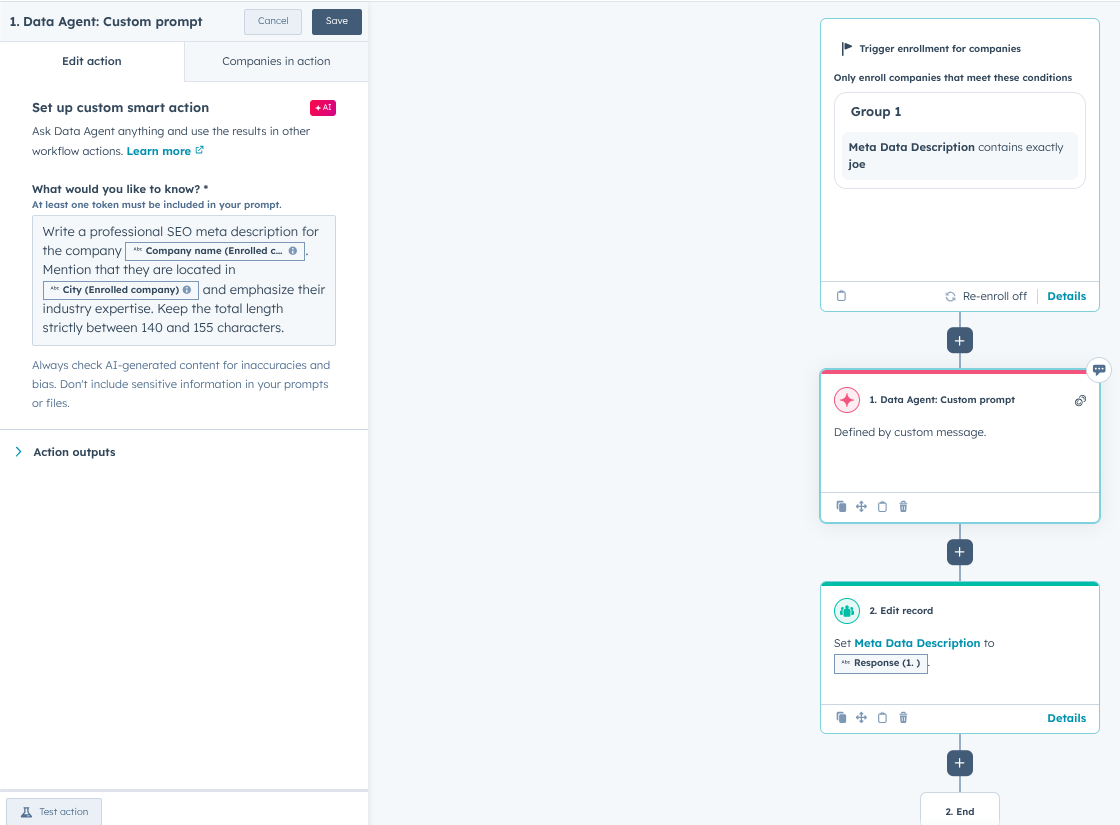
Rather than exporting data into an external AI tool and manually pasting results back in, we built the solution inside HubSpot using Breeze AI, specifically the AI Data Agent within a structured workflow.
The architecture was deliberately simple: three nodes, clear rules, zero ambiguity.
Trigger conditions:
- The metadata description field is empty
- The listing Name field is populated
Node 1: Validation - Confirm the record met the defined criteria before anything was touched.
Node 2: AI Data Agent - A custom prompt pulled the relevant listing properties, applied defined SEO standards, and generated a compliant meta description within a strict 140–155 character constraint. The output was written directly to the Metadata Description field. no copy-paste, no manual review queue.
Node 3: Record Update - The field updated automatically. Critically, it only wrote to blank fields. No existing data was overwritten.
The whole thing ran inside HubSpot's workflow logic, governed, auditable, and operating within the same permissions and data boundaries the team already used.
The Results: 1,450 Records Processed in Minutes
In a sandbox environment using fictional company data, the workflow processed all 1,450 remaining listings in minutes.
Here's what that looked like in practice:
- ~90% fully automated: records processed and updated without human involvement
- ~10% flagged for refinement: prompt optimisation and a defined test plan before production deployment
- Zero hallucinations observed
- Zero overwrites of existing data
- Quality assessed as acceptable by the client
The client approved it as the entry point for a broader automation programme.
Why This Matters Beyond SEO
The SEO metadata task was the use case. But the more important outcome was the proof of concept it established.
This wasn't AI generating content in isolation. It was:
- AI operating inside a structured, governed workflow
- Controlled field-level updates with deterministic triggers
- Business-rule-bound execution with no external tool sprawl
- A repeatable pattern that scales to other data problems
The same workflow logic applies to CRM hygiene tasks, record enrichment, ticket response automation, and anywhere else your business has high-volume, rules-based data work sitting in a backlog.
The Takeaway
If your team is sitting on a data backlog that's too large to clear manually, the question isn't whether AI can help. It's whether AI is deployed in the right place.
Dropping data into ChatGPT and pasting results back is not a scalable process. It's ungoverned, inconsistent, and creates more work to manage.
Breeze AI embedded inside HubSpot workflows is something different: controlled automation that operates where your data already lives, within the guardrails your business already has in place.
The 1,450 records took minutes. The years-long backlog was cleared before it became a competitive liability.
That's what operationalised AI looks like.



Comments