
For many businesses, lead scoring starts with good intentions.
Sales and marketing teams sit down together, brainstorm what they believe makes a “good lead”, assign points to a few actions and industries, then launch a scoring model inside HubSpot.
On paper, it sounds smart.
In reality, most lead scoring models end up:
- Overly simplistic
- Bloated with irrelevant criteria
- Disconnected from actual customer behaviour
- Difficult for sales teams to use
- And eventually ignored altogether
Not because lead scoring itself is flawed, but because most models are built on assumptions instead of evidence.
That’s where AI-Enhanced Lead Scoring changes the game.
Rather than relying on guesswork, AI can analyse the real behaviours, engagement patterns and fit signals of converted customers to uncover what actually contributes to conversion over time.
The result isn’t just a smarter scoring model.
It’s a prioritisation system your sales teams can actually trust and use.
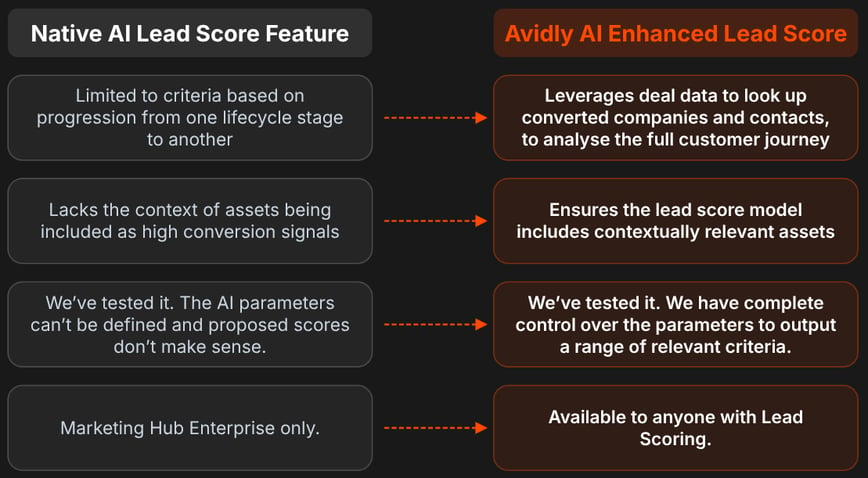
The Problem With Traditional Lead Scoring
Traditional lead scoring is usually opinion-based.
A business might say:
- “We think these page views matter”
- “We’ve worked with one construction client before, so let’s score construction companies highly”
- “This form submission feels high intent”
- “Let’s attribute points to every industry we could potentially sell to”
The issue is that none of this is necessarily backed by real conversion data.
And if a business has never built a lead scoring model before, they often don’t know what they don’t know.
So what happens?
The model becomes:
- Too broad
- Too noisy
- Full of inflated signals
- And unable to effectively prioritise leads
Instead of helping sales teams focus on the right opportunities, it creates more clutter inside the CRM.

More Scoring Criteria Doesn’t Always Mean Better Scoring
One of the most common mistakes businesses make is trying to score everything.
Every page.
Every industry.
Every interaction.
Every possible signal.
But lead scoring is not about assigning points for activity.
It’s about prioritisation.
If every action contributes to a lead score, eventually nothing stands out.
For example:
- Just because you worked with one construction company years ago doesn’t mean construction should receive a high score today
- Just because someone viewed a webpage doesn’t mean they’re sales-ready
- Just because an industry could become relevant doesn’t mean it should currently influence prioritisation
A good lead score model should reflect:
- Who is actually converting now
- What behaviours are genuinely predictive
- And which signals consistently appear in the lead-up to conversion
That’s very different from building a “catch-all” scoring system.
AI-Enhanced Lead Scoring Uses Real Conversion Data, Not Guesswork
AI-Enhanced Lead Scoring flips the process.
Instead of asking:
“What do we think matters?”
We analyse:
“What actually happened before customers converted?”
Using AI, we analyse converted companies and contacts inside HubSpot to uncover:
- Common behavioural signals
- Engagement patterns
- Recurring fit criteria
- Sales cycle trends
- Timing and frequency of actions
- Source attribution patterns
- And customer journey commonalities
For example, AI may uncover that:
- Offline lead sources convert 3x more often than paid search
- Multiple case study views strongly correlate with conversion
- Quote requests lose predictive value significantly after a certain timeframe
- Certain industries convert far less often than stakeholders assumed
- Highly engaged leads follow a specific sequence of actions before converting
These aren’t assumptions.
They’re patterns derived from real customer data.
Why Context Matters More Than Generic “Best Practices”
One of the biggest misconceptions about lead scoring is the idea that there’s a universal set of “high-intent” actions.
There isn’t.
Intent is contextual.
What signals buying intent for one business may be almost meaningless for another.
For example:
In B2B Services Businesses
Viewing multiple case studies may signal strong buying intent because prospects are researching:
- Delivery capability
- Outcomes
- Implementation approach
- And risk reduction
In B2C Ecommerce
Those same case study views might mean almost nothing.
Instead, high-intent actions may include:
- Viewing a size guide
- Repeat product visits
- Abandoned cart activity
- Or shipping-related interactions
The customer journey determines what deserves scoring.
That’s why copying another business’s lead scoring framework rarely works.
AI helps uncover what matters specifically within your customer journey.

AI Can See Patterns Humans Often Miss
Humans are good at recognising individual lead sources and conversion actions.
But AI can analyse patterns across the full sales cycle in ways most teams simply can’t do manually.
For example:
- Which lead sources convert most often over time
- How engagement decays across long buying cycles
- What combinations of actions predict conversion
- How frequently certain behaviours occur before a deal closes
- And which actions lose value as time passes
A quote request submitted yesterday may be highly valuable.
The same quote request submitted 12 months ago without further engagement probably isn’t.
Traditional lead scoring often ignores this nuance entirely.
AI helps refine:
- Score decay
- Timing
- Engagement recency
- Behavioural frequency
- And action sequencing
This creates a much more accurate prioritisation model, especially for businesses with longer B2B sales cycles.
AI Should Inform Scoring, Not Replace Human Decision-Making
One of the biggest misconceptions about AI-enhanced lead scoring is that AI should completely automate qualification.
It shouldn’t.
AI should enhance decision-making, not replace it.
The goal is to use AI to:
- Identify real conversion patterns
- Surface high-priority opportunities
- Reduce guesswork
- And improve confidence in prioritisation
But experienced sales and marketing teams still bring:
- Context
- Commercial understanding
- Customer knowledge
- Strategic direction
- And human judgment
AI can only analyse tracked behaviours and fit signals.
It cannot fully replace the expertise of teams who understand:
- Market positioning
- Relationship quality
- Deal complexity
- Or strategic business direction
The best lead scoring systems combine AI-driven insights with human validation and experience.
A Great Lead Score Is About More Than the Model
This is where many lead scoring projects fail.
Even if the scoring logic is technically sound, the model becomes useless if nobody uses it.
A lead score hidden inside a contact record doesn’t automatically improve sales performance.
Sales teams need:
- Visibility
- Accessibility
- Workflows
- Prioritisation
- And operational integration
That’s why AI-Enhanced Lead Scoring should include:
- Automated prioritisation lists
- Sales notifications
- Workflow automation
- Lead threshold segmentation
- And actionable sales handover processes
The goal is not just to calculate a score.
The goal is to create a system that helps teams act faster and more confidently.
Why Rollout and Optimisation Matter
The first version of a lead score model is rarely perfect.
That’s why rollout and optimisation are critical.
During rollout:
- Leads are reviewed against scoring thresholds
- Sales and marketing teams validate prioritisation quality
- Adjustments are made to improve accuracy
- And documentation is provided to explain:
- Why contacts are scoring highly
- What signals matter most
- And how the model works
This process is incredibly important for trust.
Because lead scoring adoption doesn’t happen automatically.
Teams need to see:
“Yes, these genuinely are our best leads.”
Once that confidence exists, sales teams stop ignoring the model and start acting on it.
The Real Business Outcomes of AI-Enhanced Lead Scoring
When lead scoring is done properly, the impact goes far beyond a number inside HubSpot.
Faster Sales Prioritisation
Sales teams can identify highly engaged leads earlier and respond faster without digging through CRM activity manually.
Improved Sales Efficiency
Teams spend less time chasing inflated or low-quality leads and more time focusing on opportunities likely to convert.
Better Sales and Marketing Alignment
Marketing hands over leads that are genuinely sales-ready, improving trust and collaboration between teams.
Greater Confidence in Decision-Making
Scoring is backed by real conversion data and validated against human experience.
More Actionable CRM Processes
Lead scoring becomes embedded into day-to-day workflows instead of sitting unused inside the system.
A Lead Score That Sits Idle Is an Opportunity Left on the Table
The reality is:
Most lead scoring models fail because they stop at scoring.
AI-Enhanced Lead Scoring works differently because it focuses on:
- Real customer behaviour
- Operational usability
- Workflow integration
- Human validation
- And continuous optimisation
The goal isn’t to replace your sales team.
It’s to give them a smarter starting point.
Because when lead scoring is built on real data and operationalised properly, it stops being a passive CRM feature and becomes a reliable engine your teams can actually drive.
Ready to turn your lead scoring model into something your sales team can actually use? Book a meeting with one of our experts to see how this will work for your business 


Comments